Excerpt from Spontaneous Combustion: Discovering
the Customer's Problems, Passions and Priorities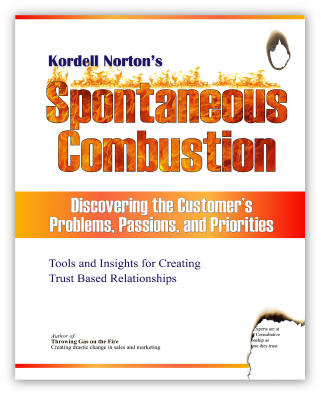
by Kordell Norton
Special note: This book is a graphic wonder. The text below is just that. . . text. The images and graphic tools are missing.
Introduction
|
T |
his book is about a technique that will allow you to say less and sell more. It has a method for combining four types of questions for consultative sales and also provides a tool to capture the answers. It moves sales from being a manipulative event to an environment of trust, consultative conversations and making you an expert.
“To boldly go where no man has gone before.” So states the mission of Captain James T. Kirk of the Starship Enterprise. Fortunately Captain Kirk and his intrepid band of explorers had fantastical devices that allowed them to get out of many a scrape.
 Like
those imaginary space explorers, we have real world devices to get us out of
(or into) various predicaments. The answer to any question seems but a few key
strokes away or a flick of a finger on some fun device. The quick and easy
access to answers is changing the value of relationships. In the past,
information was of high value. Not anymore. Now value is in the relationship
with someone who knows where to find the answer. More and more we value the
person who can put everything into perspective.
Like
those imaginary space explorers, we have real world devices to get us out of
(or into) various predicaments. The answer to any question seems but a few key
strokes away or a flick of a finger on some fun device. The quick and easy
access to answers is changing the value of relationships. In the past,
information was of high value. Not anymore. Now value is in the relationship
with someone who knows where to find the answer. More and more we value the
person who can put everything into perspective.
Recently our family washing machine was declared beyond repair. Before journeying to the local store I spent 15 minutes surfing the internet for information, reviews and research. When my wife and I arrived at the first store, it took just a few minutes to determine that the salesperson was more interested in extended warranty contracts than they were on addressing our needs.
At the third store in our buying saga, we found our expert. After a series of questions about our family, our financial budget and our lifestyle, our sales woman expert was able to show us a washing machine that would meet our needs. We spent almost three times the amount we had originally budgeted (can you hear that sucking sound on my wallet?). She asked questions that got to the core of our priorities, and problems. Armed with our information she was able to recommend, as an expert, the right solution. She had changed our status quo.

Today, business is about changing the status quo. You want new prospects to start buying from you and your current customers to buy more. Both require you to rock the boat.
Most of today’s selling techniques were created for a world of manufacturing and packaged goods. Those selling skills are almost 150 years old. Today’s customer recognizes those tactics as old with their descriptions like: features, benefits, closing techniques, and overcoming objections. Today, the customer does NOT appreciate these manipulative methods and are moving their purchases where pressure tactics are not used. Are we really surprised by the financial difficulty of the U.S. car manufacturers in the recession of 2008/2009 based on their sales tactics? Their mantra of “We don’t need to listen to the customer” just doesn’t cut it anymore. Their “they will buy whatever we chose to make for them” philosophy is their undoing.
With the arrival of business at hyper-speed and the quick availability of information, business will have to change from the past. Today’s customer senses manipulative selling. They move away and take their dollars with them. Scarcity is no longer the thing of value. The new value is in relationships and connections. To have a relationship requires a true two way communication. You have to listen.
How many great experiences have you had in buying a car from a dealer lately? What about that visit to the local gym as you consided losing a few pounds? We see these experiences as alternatives to a good root canal. There are many alternatives to escape this kind of treatment! Customers are voting with their dollars for more authenticity, trust and honesty. Respect shown by the seller is the imperative
New selling skills are needed that focus on openness, service, and becoming a trusted advisor. Phrases like, “What is it going to take to get you into this car today?” or “Would you like that piece of furniture in green or blue?” are laughable.
This book will provide you with an elegant and simple tool that will move you into a new world of trust and deeper and more meaningful business relationships. Whether you are a sales person, a consultant or business professional, you are in the right place. By combining the need to change the status quo with consultative skills you will
· Become a trusted expert and advisor!
· Become an asset for the customer.
· Develop something that will set you apart from the competition.
· Find that you can deliver your goods and services with a focus on value instead of price. (That’s right; you can overcome the price objection.)
· Make your customers more motivated and willing to “buy” your offerings at a higher rate than before.
· You will indeed discover that true professionals say less ... and sell more.
Kordell Norton
|
Chapter 1 |
The Discovery
|
I |
felt the blood race to my face in an embarrassed flush. My mind tracked back 60 seconds in the conversation.
 “You
know,” I said with a weak smile, “the old manipulative selling methods are
really out of place. Today, everybody needs the skills that allow them to be
conversational. They need the ability to establish credibility as a trusted
advisor.”
“You
know,” I said with a weak smile, “the old manipulative selling methods are
really out of place. Today, everybody needs the skills that allow them to be
conversational. They need the ability to establish credibility as a trusted
advisor.”
She, an experienced sales executive, was in charge of a large organization. An hour long conversation was coming to an end. We had been talking about how to help her people build stronger sales relationships. Having agreed on a course of direction, the conversation was winding down.
“There’s a lot of cutting edge knowledge on how to improve sales,” I said, leaning forward, “but once the learner gets back to their work, they revert to old behaviors. We will be able to give your folks a tool that will move them to a position of consultant and trusted advisor.”
“That’s what I want,” she said, smiling.
I closed my EPRS notebook (more on the notebook shortly) and slid it into my bag. “We can change their behavior and help them build powerful relationships.” Smiling, I stood up and said, “This process is so powerful that there are times when I am walking to the door and the customer asks ‘what is this going to cost me?’ Imagine getting a sale without ever having talked about price.”
She looked at me and said, “As a matter of fact, what IS this going to cost me?”
Again I was embarrassed and amazed at how well this process worked.
The Reese’s Peanut Butter Cup Concept
Two Ideas Combined
There was an old advertising campaign that featured two individuals, one who loved chocolate and the other peanut butter. They walked down the street, oblivious to the other person approaching, each eating their favorite food. A collision occurs with chocolate and peanut butter intermixing. Quickly tasting the combination, smiles appear and the tag line of what a great treat chocolate and peanut butter would be. The consumer was encouraged to go out and buy a delicious Reese’s Peanut Butter Cup.
My Reese’s Moment
A few years ago I discovered an emerging business tool called “Graphic Facilitation.” Let’s call this note taking “the peanut butter.” This process, pioneered by David Sibbet, is used by organizations to do things like: improve teamwork, create strategic plans, improve processes and make communication more effective. Using large wall sized pieces of paper, a Graphic Recorder gathers “group wisdom” using markers, words and pictures. Very fast and highly visual, it allows a group to communicate and make decisions quickly. I adopted this process and used these simple methods as a facilitator for executive retreats, planning sessions and in presentations for large groups. The key here is recording what people say.
The second part of my Reese’s moment (the “chocolate” part) came when a client asked me to do some training for their corporate sales group. They had recently purchased their own training materials and asked if I could teach them how to “sell” their sales training and how they should conduct their own classes. Their cutting edge materials moved a salesperson to be more consultative and relationship oriented.
The epiphany arrived.
“What would happen if I combined consultative selling and graphic recording?”
I tried it on a sales call. Wow! The customer opened up like the sun after a spring shower. The second time gave even better results. Like the Reese’s Peanut Butter Cup, an incredible innovation occurred in relationship building. Conversations with customers erupted in trust and warmth.
Appropriate was the quote of Victor Hugo, who said,
“There is one thing stronger than all the armies in the world, and that is an idea whose time has come.”
The customer relationship now seemed to spontaneously combust with energy and trust. I found a natural evolution from being concerned about “the sale” and found in its place a comfortable way of moving toward the customer’s world in an engaging way. I had discovered the spontaneous combustion of a deep and sincere connection with the client.
I was capturing the insights of client conversations with intense note taking and found myself getting deeper into their world, and problems. By combining this note-taking method with the key questions used in modern selling, I was becoming more and more the expert and the trusted advisor. Then, as I shared these new methods with others, I quickly heard stories of amazing success from my clients as well. My sales were up, but I was surprised when one large organization indicated growth of 40% plus in just a few months using my discovery.
Education is learning and practicing a new skill until it becomes a habit. When this happens, we can exercise the “adopted” without even thinking. This allows us to perform without worrying about the “mechanics.”
The problem lies in changing old habits. What happens when the old stuff doesn’t work anymore? How do we change our behavior? What happens when the salesperson reverts back to the old? To learn about better relationships and then to expect your behaviors to change is no more likely to occur than to declare that you are now a world class athlete because you watched the Olympics.
There are armies of business people who are armed with antiquated skills and methods like “Closing Techniques” and “Overcoming Objections.” But if everyone is using gunpowder, why continue to use your supply of bows and arrows? To get past these old selling behaviors, requires a new tool, like throwing away the quiver of arrows and picking up a gun.
Today, the consumer has so many choices. Put the bow and arrow down and step away. To become the customers trusted advisory, their expert in a world full of unlimited choices you need to be connected – at a deep level.
So how can you change current behavior to capture the customer’s priorities, passions and problems?
Say less … sell more.
Are you talking to me?
Years ago I worked with one of the brightest minds in the technology world. In one meeting, this executive was reviewing the market and the competition. When he got to one major competitor, he commented, “They not only don’t know the answers ... they don’t even know the questions.” Given the setting his response was hilarious. Since then I have come to see the seriousness of his comment.
The value of a great man is not the answers they know but the questions they ask
At the core of great relationships are questions. The ability to ask and put a value on the answers is like combining fuel, oxygen and heat to create fire.
The answers to the right types of questions will cause a spontaneous combustion of energy and motivation by the customer.
Whether you are selling widgets or are a doctor, accountant or other professional, the following information will make you more valuable. Why? It is simple. Talk less…sell more. In proactive listening there is the catalyst to igniting the fires (spontaneous combustion) in your client.
If this book does not look at the whole sales cycle ... where does it help? It helps with probing, deeper conversations and digging deeper into the customer’s world! It will help you to probe, discover, explore, understand, comprehend and uncover the customer’s priorities, passions and problems (see appendix).
This book is divided into two parts.
Part 1- Four Types of Consultative Questions
(the chocolate)
The power is in the one-two punch of combining the questions with a method to record the answers. This process will put you and your customer on the “same page.”
There is also a section to explain note taking methods before the sales template pages.
Part 2 - Sales Call Recording Templates
(the peanut butter)
 Later
we will explain a recording method. In the back portion of this book you
have a simple “template” for use in your sales calls. The metaphor used on the
templates should spark your memory on where you are in the conversation. This
metaphor is in the form of a simple picture, or graphic. These sheets will look
professional to your customer. We know. We have been using them for years.
Later
we will explain a recording method. In the back portion of this book you
have a simple “template” for use in your sales calls. The metaphor used on the
templates should spark your memory on where you are in the conversation. This
metaphor is in the form of a simple picture, or graphic. These sheets will look
professional to your customer. We know. We have been using them for years.
“Use the Force, Luke. Trust in the Force.”
Obi-Wan Kenobi
As you read, you will see that the four types of questions flow quite naturally. There may be times when you feel like the questions are too pointed, too direct or perhaps trite or even simple.
My advice is to “trust the force” and use the four types of questions and the recording templates. You too can experience the full power and force of relationships built with consultative skills. You will get to the place where your customers feel that someone is finally listening to them. You will be amazed as the customer opens up deeply and you discover their hearts and minds.
You will experience the miracle of the George Elliott quote:
“Oh, the comfort, the inexpressible comfort of feeling safe with a person, having neither to weigh thoughts nor measure words, but pouring them all out, just as they are, chaff and grain together, certain that a faithful hand will take and sift them, keep what is worth keeping, and with a breath of kindness blow the rest away.”
The value of a man is the questions that he asks.
Let’s make you valuable.